
The 4.7 Illusion: Why a Strong Rating Is No Longer Enough in NYC
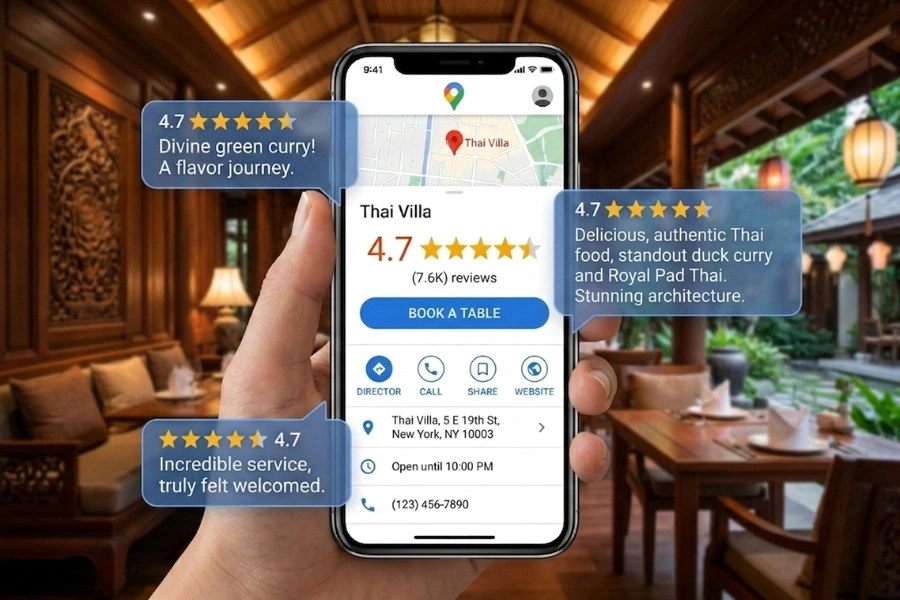
A 4.7 rating used to be a moat. In 2026, it is the floor. Walk down any block in the East Village, the West Village, Williamsburg, or Long Island City, and you will find five restaurants within 200 feet, all sitting between 4.5 and 4.8 stars. Guests are not picking based on rating anymore. They are picking based on certainty. A rating tells them you are not bad. It does not tell them you are right for tonight. That decision is shaped by a dozen invisible signals: what the room looks like in tagged Stories, what TikTok shows when they search your name, how recent your photos are, whether the menu looks confident or chaotic, and whether the vibe online matches the vibe they want.
This is the new reality of restaurant reputation management. Your score is not the issue. Your signal is weak.
What Guests Actually Check Before Booking (It’s Not Just Google)
NYC diners do not make a single-tap decision. They run a multi-platform audit, usually in under 90 seconds, before they hit “Reserve.” Here is what that audit really looks like:
Stage | What Guests Check | What They Are Really Asking |
1. Discovery | Google rating + Maps photos | “Is this place legit?” |
2. Vibe Check | Instagram grid + tagged posts | “Will I feel good here?” |
3. Social Proof | TikTok search of your name | “Is anyone actually going?” |
4. Risk Check | Recent reviews (last 30 days) | “Has it gone downhill?” |
5. Friction Check | Reservation flow + menu link | “Is this easy or annoying?” |
A 4.7 only wins Stage 1. Stages 2 through 5 are where most NYC restaurants quietly lose the booking — and they never see why, because nothing shows up in the reviews.
That is why online reviews of restaurants focus only on the entry ticket. The booking is won or lost in the off-platform reputation signals that follow.
Why Great Reviews Still Don’t Convert Into Covers
If your dining room is empty despite strong ratings, you are not dealing with a review problem. You are dealing with hidden brand perception issues. These issues usually show up in four patterns:
- The story is unclear: Reviews say “great food,” but guests cannot tell what occasion you are on, for date night, business lunch, group dinner, or casual drop-in.
- The proof feels stale: Your latest tagged content is six weeks old. To a NYC diner, that reads as “closed or struggling.”
- The friction is invisible: Repeated micro-complaints about pacing, the host stand, or check-drop never make it to 1-star reviews, but they show up in DMs and group chats.
- The vibe is mismatched: Your website says “intimate.” Your Instagram says “trendy.” Your Yelp photos say neither. Guests pick certainty, so they pick someone else.
This is where customer sentiment analysis for restaurants becomes critical. You are not just reading reviews; you are decoding the patterns that block reservations.
Rating vs. Reputation: The Gap That Costs You Covers
Most operators confuse these two. They are not the same thing.
Rating | Reputation |
A single number on Google | A full perception across platforms |
Updated slowly | Updated daily by guests, posts, and comments |
Tells you the past | Tells you what to expect tonight |
Easy to track | Requires social listening; restaurants can act on |
Vanity metric | Revenue metric |
A 4.7 rating with a weak reputation is a leaking bucket. You can keep collecting reviews, but the signal guests actually use to decide is broken somewhere else. That is why a proper review management strategy is not “reply faster to Google.” It is closing the gap between what your rating says and what your signal shows.
What Restaurant ORM NYC Actually Looks Like When It Works
When operators search for restaurant review management in NYC, they are not asking for canned responses. They are asking why trust is not converting into bookings. Restaurant ORM NYC (online reputation management) is a system, not a service. It has three working parts:
- Capture: Track reviews, mentions, tags, search results, and DMs weekly. Not monthly. Weekly.
- Interpret: Run customer sentiment analysis restaurants can act on and find the themes, not the outliers.
- Correct: Fix the operational cause and the perception layer at the same time.
The operators who win in NYC are not the ones with the most reviews. They are the ones who treat restaurant brand monitoring like CRM data, tracked, segmented, and acted on.
The Weekly Reputation Snapshot Every NYC Operator Should Run
Here is the system MCS recommends for serious operators. Run this every Monday, 30 minutes max.
Signal Source | What to Pull | What to Look For |
Google Reviews | Last 10 reviews | Themes, not stars |
Yelp + OpenTable | Last 10 mentions | Repeated objections |
Instagram (tagged) | Last 15 tagged posts | What guests show vs. what you post |
TikTok Search | Top 5 results for your name | Recency and tone |
DMs + Comments | Last 7 days | What people ask repeatedly |
This is restaurant brand monitoring in the way NYC actually requires. Once you see the patterns, you can identify the one bottleneck costing you the most coverage and fix it before it spreads.
When ORM Isn’t Enough: The Fractional CMO Layer
Sometimes the issue is not your reviews. It is your positioning. If guests do not instantly understand what your restaurant is for (the occasion, the vibe, the price tier, the reason to choose you tonight), no amount of 5-star ratings will fix demand. Ratings build trust. Positioning drives choice, and in NYC, where a diner has 40 other options within a 10-block radius, unclear positioning is a silent killer.
That is when a fractional CMO for restaurants approach matters. Not someone who only posts content or replies to reviews, but someone who looks at the full picture:
- Brand promise: What you are saying you are
- Guest experience: What you are actually delivering
- Digital proof: What guests see before they decide
- Conversion flow: How easily a curious diner becomes a confirmed reservation
Because you can have online reviews, restaurants would envy and still lose bookings to the place next door that simply makes its identity clearer in 10 seconds. That is the gap a strong review management strategy alone cannot close. It needs positioning behind it.
Your Reputation Is a Revenue System, Not a Score
A 4.7 is not the finish line. It is the starting line. The restaurants that fill tables in NYC are not the ones with the highest ratings. They are the ones with the cleanest signals. They track off-platform reputation signals. They run customer sentiment analysis that restaurants can actually act on. They fix hidden brand perception issues before those issues turn into empty Tuesdays. And they treat social listening in restaurants as a weekly discipline, not a quarterly project. That is the real difference between a well-reviewed restaurant and a consistently booked one.
My Chef Social helps NYC operators build restaurant reputation management systems that turn ratings into reservations. From review tracking to restaurant brand monitoring to sharper positioning, every piece is built to do one thing: get more guests through your door, more often. If your dining room is quiet despite a strong rating, the answer is not more reviews. It is better signals, clearer positioning, and a tighter feedback loop between what guests see online and what they feel inside your restaurant.
Let’s turn your 4.7 into a full dining room →
Frequently Asked Questions
Why do I have great reviews but low reservations in NYC?
Because guests validate you across platforms before booking. Reviews are only step one. What people see on Instagram, TikTok, tagged posts, and DMs usually decides whether the reservation actually happens.
What is restaurant ORM NYC (online reputation management)?
Restaurant ORM NYC (online reputation management) is the full system of capturing, interpreting, and correcting reputation signals across every platform guests use to validate a restaurant, not just Google or Yelp.
Is replying to reviews enough?
No. Replying is hygiene. Real restaurant reputation management uses sentiment patterns to identify root causes, fix the guest experience, and tighten the proof people see online.
How often should NYC restaurants monitor their brand perception?
Weekly is the baseline. NYC moves fast, and perception can shift in days, not months. A consistent monitoring rhythm prevents small signal gaps from turning into demand problems.
When do I need a fractional CMO instead of just ORM?
When the issue is not reviews but positioning. If guests cannot tell what your restaurant is for, a fractional CMO for restaurants helps align brand, marketing, and operations so your reputation actually converts into covers.