
Discounting Is a Revenue Tool That Quietly Destroys Brand Equity
Let’s be precise about what a discount actually does operationally. When you offer 20% off via a third-party platform, a Groupon-adjacent deal, or a Sunday night “special,” you are not just reducing one transaction’s margin. You are training a high-value guest segment to wait. You’re establishing a psychological floor below your actual price point. And you’re fundamentally undermining the perceived value signal that justifies your labor costs, your sourcing standards, and your real estate overhead.
In NYC, where a single 1,500 sq. ft. dining room on a secondary Midtown block might carry $35,000–$55,000 in monthly rent, the math on discount-driven volume is brutal. You need significantly more covers just to land at the same net revenue, while simultaneously absorbing the costs of serving more guests: higher labor, faster linen turnover, and accelerated equipment wear.
The operators who win long-term in this market don’t sell more by charging less. They sell more by making guests feel the price is irrelevant to the experience they’re receiving. That distinction is the entire architecture of premium restaurant positioning and one of the most important levers in protecting restaurant profit margins.
Value Perception Is a System, Not a Price Tag
- Perceived value dining is not about what you charge. It’s about the gap between what a guest expects to pay and what they feel they received. The most sophisticated restaurant brands in NYC engineer that gap deliberately. Consider the components of value that have nothing to do with price reduction:
- Narrative and provenance. A 48-hour fermented rye bread isn’t just bread; it’s a story. Guests who understand why something costs what it costs become advocates, not complainers. This is where restaurant branding agency NYC’s work pays its highest dividends: translating operational obsession into guest-facing language that makes the price point feel like a bargain.
- Consistency is a premium signal. Inconsistency destroys perceived value faster than any competitor’s price cut. When a guest returns and the experience has drifted to a different pour level, an imprecise plate presentation, or a server who doesn’t know the sourcing story, they recalibrate downward. Operational consistency is, functionally, a pricing defense mechanism.
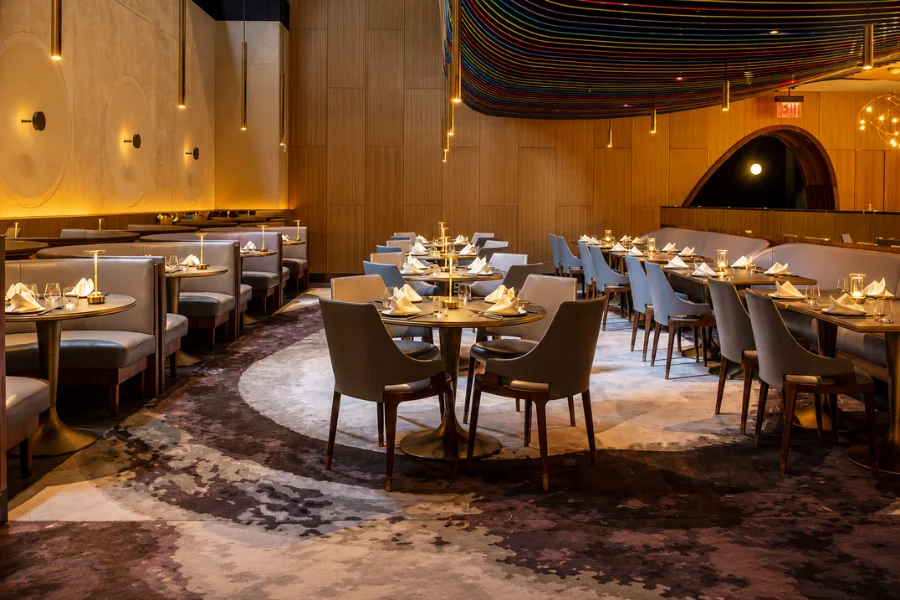
- The ambient experience multiplier. Lighting, sound design, tableware weight, and the texture of a menu card; these cues communicate price appropriateness before a single dish arrives. Guests in premium spaces self-select into accepting premium prices because the environment has already told them the price is legitimate.
- Exclusivity mechanics. Controlled scarcity reservation lead times, limited seating configurations, and tasting menus that require advance commitment communicate that a seat at your table is worth competing for. That competitive signal anchors value far more effectively than any promotional campaign.
The Hidden Cost: Discounting vs. Value Investment
The following comparison benchmarks the downstream financial impact of two divergent approaches to restaurant brand strategy for a hypothetical 60-seat NYC restaurant operating at typical Manhattan cost structures.
Metric | Discount-Driven Model | Value-Investment Model |
Average Check (per cover) | $72 (after 18% avg. discount) | $88 (no discount) |
Required Covers to Hit $25K Weekly Revenue | ~347 covers | ~284 covers |
Est. Additional Labor Cost (higher volume) | +$1,800–$2,400/wk | Baseline |
Repeat Guest Rate (90-day window) | 18–22% | 34–41% |
Customer Lifetime Value (est. 24 months) | ~$320 | ~$780 |
Brand Positioning Drift Risk (12 months) | High-guest anchor to discounted prices | Low-price integrity maintained |
Social Proof / Organic Referral Rate | Moderate (deal-motivated guests) | High (experience-motivated guests) |
Avg. Online Review Sentiment Score | 3.9–4.2 | 4.4–4.7 |
Disclaimer: All figures above are illustrative benchmarks compiled from industry data sources, including the Toast Restaurant Trends Report, the National Restaurant Association’s State of the Restaurant Industry reports, and Deloitte Consumer Insights on hospitality experience economics. They model directional patterns and should not be treated as projections for any individual operation. Operators are advised to cross-reference these benchmarks against their own verified POS data, labor cost actuals, and loyalty program analytics before drawing strategic conclusions.
If you’re looking to increase restaurant revenue without relying on discount mechanics, the value-investment model above outlines exactly where the leverage is.
Want to understand where your restaurant stands?
Schedule your free strategy session today →
Menu Pricing Psychology: The Architecture of Profitable Menus
Menu pricing psychology is a discipline that operators often relegate to an afterthought: a final formatting pass before print. In reality, menu architecture is one of the highest-leverage tools in a restaurant’s competitive advantage toolkit. A few principles that separate operators who understand this from those who don’t:
- Anchor pricing. Place your highest-margin items adjacent to your most expensive items. The $58 prime ribeye makes the $42 heritage chicken feel like a calculated, reasonable choice, even if the chicken carries a 30-point better margin.
- Eliminate dollar signs. Research in consumer psychology consistently shows that currency symbols activate “pain of paying” cognition. Menus without dollar signs generate measurably higher average checks.
- Price point clustering. Avoid creating obvious pricing tiers that invite direct comparison. When entrées cluster around $36–$44, guests stop price shopping and start experience shopping.
- Verb-forward descriptions. Language that describes process, slow-braised, hand-rolled, or wood-fired implicitly justifies elevated prices without demanding justification. It shifts the frame from “is this expensive?” to “how did they do that?”
These mechanics, executed deliberately, are core components of any serious restaurant marketing and branding NYC engagement because great brand presentation and great menu design are inseparable.
The Operators Who Get This Right Are Playing a Different Game
The luxury restaurant marketing paradigm in New York isn’t reserved for Michelin-starred tasting rooms. It’s a mindset that applies to a $55-average-check neighborhood bistro in Greenpoint or a wine-forward trattoria in the West Village just as much as it does to the flag-bearers on the 50th floor.
What these operators share is a refusal to compete on price. They understand that in a market where restaurant brand differentiation in NYC is the only durable moat, discounting is a form of competitive surrender. It says our experience alone is not sufficient to justify our prices. That is an extraordinarily damaging message to send, and once sent, it is very difficult to unsend.
The operators who endure in this city invest instead in three non-negotiable areas: brand clarity (who they are and who they’re for), experience consistency (delivering on the brand promise at every table, every shift), and guest relationship infrastructure (CRM workflows, loyalty mechanics, and targeted reactivation that make regulars feel seen rather than marketed to).
If you find yourself reaching for a discount lever, the right diagnostic question is not “how much should I discount?” It’s “Where has our value delivery drifted from our brand promise?”
You can also explore how restaurant social media in NYC supports brand equity without promotional dependency, visibility that attracts experience-motivated guests, not deal-seekers.
A Final Word on Winning the Long Game in NYC
The operators who build institutions in this city, the ones that survive economic cycles, labor shocks, and the relentless pressure of new competition, are not the operators with the most aggressive promotions. They are the operators with the most coherent brands, the most disciplined pricing integrity, and the deepest investment in guest experience as a system, not a series of one-off moments.
If your current restaurant brand strategy in NYC relies on promotional velocity to fill seats, that’s not a marketing problem. It’s a positioning problem, and it requires a structural solution, one built on value architecture, not discount mechanics. The good news: that solution is within reach for any operator willing to pursue it.
At My Chef Social, we help restaurant operators develop growth-focused strategies that support stronger profitability, better operational efficiency, and sustainable long-term success. Protect your margins before rising costs erode them further.
Schedule your free strategy session today →
FAQs
What is the most effective restaurant pricing strategy for NYC restaurants?
The most effective restaurant pricing strategy in New York City is one built on value architecture rather than promotional mechanics. That means anchoring price to a clearly articulated brand promise, engineering perceived value through narrative, consistency, and experience design, and maintaining price integrity across all channels. Operators who resist discounting and invest in guest experience as a system consistently outperform those who compete on price — particularly in a market where rent and labor costs leave almost no margin for discount-driven volume plays.
Why is discounting bad for restaurant brand equity?
Every discount trains guests to expect a lower price as the baseline. Over time, this creates a segment of deal-motivated diners who will not return at full price, eroding both your average check and your repeat guest rate simultaneously. More critically, discounting sends an implicit signal that your full-price experience cannot justify its own cost, which is one of the most corrosive messages a brand can communicate in a high-competition market like Manhattan.
How does perceived value affect restaurant profitability?
Perceived value determines how much a guest believes they received relative to what they paid. When perceived value dining is high because the narrative, environment, consistency, and service all reinforce the price point, guests return more frequently, spend more per visit, and refer others organically. These three compounding behaviors (retention, higher average check, and referral) are the primary drivers of customer lifetime value, which is the metric that actually separates sustainable restaurant businesses from ones that require perpetual promotional spending to fill seats.
How should NYC restaurant operators price their menus?
Menu pricing in NYC should be driven by four principles working in concert: anchor pricing (using high-ticket items to reframe the value of adjacent, higher-margin items); elimination of currency symbols to reduce price sensitivity; clustering entrée price points to shift guests from price shopping to experience shopping; and verb-forward menu pricing psychology that communicates craft and process. Taken together, these mechanics elevate perceived value without altering the actual cost of a single item.
What is the role of brand strategy in restaurant pricing?
Brand strategy and pricing strategy are not separate disciplines; they are the same discipline viewed from different angles. Your price point is a brand statement. It communicates who your restaurant is for, what category it occupies, and what standard of experience a guest should expect. Operators who treat pricing as a financial decision isolated from brand positioning consistently leave revenue on the table because they are not leveraging the full value of the identity they have built.