
Why That First Warm Day Carries Disproportionate Weight
Every year, it follows the same pattern. Manhattan gets weeks of inconsistent weather through March and early April, a mild afternoon, a cold snap, rain, and another tease of warmth. Then, typically between mid-April and early May, the temperature holds at or above 65°F, skies stay clear, and the city collectively decides it’s spring.
That single day doesn’t just change the mood on the street. It changes foot traffic measurably. Pedestrian analytics from Placer.ai’s 2025 Q1 Urban Mobility Report confirm that foot traffic in high-density Manhattan corridors, including the West Village, SoHo, the Upper West Side, and Midtown East, increases by 18 to 27 percent on the first day temperatures reach 65°F. The National Restaurant Association’s 2025 State of the Restaurant Industry Report notes that restaurants with functional exterior seating in urban markets see significant same-day demand surges compared to interior-only operations during early warm-weather windows.
This is not a gradual transition. It is a spike, a single-day surge that rewards operators who are already set up and penalizes those still waiting on permits, furniture deliveries, or staffing adjustments. As NYC outdoor dining 2026 season approaches, the operators who capture early demand are those who prepared weeks in advance. The restaurants that fill their sidewalk tables on that first warm day are not lucky. They are simply early.
What the City Actually Requires: Sidewalk Cafe Permit NYC Compliance Checklist
One of the most common and costly mistakes Manhattan restaurant operators make each spring is assuming last year’s approvals carry forward automatically. They often do not, or they carry forward with conditions that have changed. New York City’s regulatory framework for exterior restaurant seating has undergone significant revision in recent years. The permanent open restaurant program, administered by the NYC Department of Transportation (DOT) in coordination with the Department of Buildings (DOB) and the Department of Health and Mental Hygiene (DOHMH), replaced the temporary pandemic-era structures with a permanent, codified permitting system that carries specific annual compliance requirements. Key requirements operators should verify well before warm weather arrives:
- Active sidewalk cafe or roadway cafe authorization under the current DOT program, including any renewals or modifications filed for 2026
- DOB compliance for any structural elements, barriers, planters, or overhead coverage that qualify as building alterations or require a separate sign-off
- Compliance with updated DOT design guidelines specifying materials, dimensions, accessibility clearances, and prohibited configurations
- Current Certificate of Insurance listing the City of New York as an additional insured, meeting the program’s minimum coverage thresholds
- Health department sign-off confirming the exterior area is included in the restaurant’s approved operating plan
- ADA-compliant pedestrian clearance, maintaining a minimum unobstructed sidewalk path typically eight feet on most Manhattan sidewalks
- No outstanding violations or unpaid fines from previous seasons that could delay or block renewal
Requirement | Administering Agency | Typical Lead Time | Common Pitfall |
Sidewalk / Roadway Cafe License | NYC DOT | 4–12 weeks (new); 2–6 weeks (renewal) | Assuming the prior year’s license auto-renews without condition changes |
Structural Compliance | NYC DOB | Varies by scope | Unapproved barriers or overhead elements triggering DOB violations |
Design & Layout Compliance | NYC DOT | Concurrent with the license | Using non-compliant furniture or barriers from a previous season |
Health Department Inclusion | NYC DOHMH | Concurrent with the license application | Exterior area not reflected in the current inspection plan |
Certificate of Insurance | Private insurer / NYC DOT | 1–3 weeks | Lapsed policy or incorrect additional insured language |
ADA Pedestrian Clearance | NYC DOT / DOB | Immediate (self-assessment) | Furniture encroaching on the required clearance width |
Fire Safety & Egress | FDNY (where applicable) | Varies | Blocked egress paths from heaters, planters, or furniture |
Sources: NYC Department of Transportation, Open Restaurants Program Guidelines (2025); NYC Department of Buildings, Sidewalk Cafe and Outdoor Structures Compliance (2025); NYC DOHMH, Food Service Establishment Permit Requirements (2025). Lead times are estimates based on publicly available processing guidance and may vary by application completeness and seasonal volume.
The operators who treat this as a checklist to complete in February and March, not a scramble to begin in April, are the ones with guests outside on that first 65°F day.
The Physical Setup Is Only Half the Equation
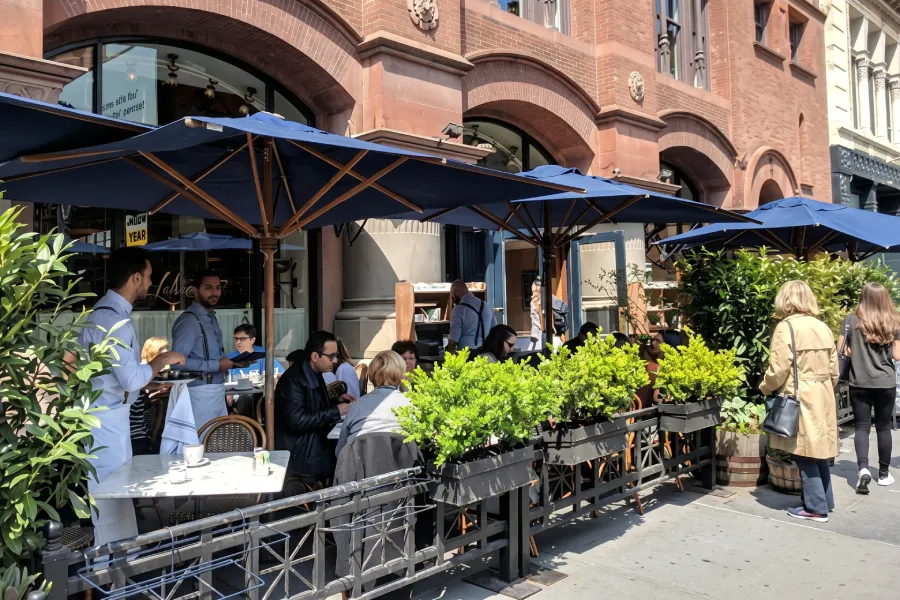
Having a valid sidewalk cafe permit in NYC and tables in place does not mean the exterior area is ready to generate revenue efficiently. Patio dining in NYC introduces a fundamentally different service dynamic than interior-only operations, one that requires adjusted staffing, menu calibration, and layout planning from day one. The transition to hybrid indoor-outdoor service changes almost every dimension of how a restaurant functions.
Furniture and Layout
Outdoor furniture stored since October needs more than a wipe-down. Inspect for:
- Structural integrity: Wobbly legs, rusted joints, cracked seats, loose hardware
- Comfort and appearance: Stained or faded cushions signal neglect, not invitation
- Current compliance: Dimensions and materials that matched last year’s guidelines may not match this year’s
Layout matters equally. An exterior section that is technically permitted but poorly arranged, with tables too close together, server paths crossing pedestrian flow, and no host stand sightline, will slow service and reduce covers per hour rather than increase them.
Service Flow and Staffing
Exterior seating creates a fundamentally different service dynamic:
- Longer travel distances between the kitchen and outdoor tables increase plate delivery times and can reduce throughput
- Exposure to weather variability, such as a sudden gust, unexpected rain, or a shift in direct sun, affects guests’ comfort immediately and requires flexible contingency planning
- Split attention for servers managing both indoor and outdoor sections increases error rates and slows table turns if sections are not drawn carefully
- Host and seating management become more complex when capacity shifts between interior and exterior based on real-time conditions
Operators who do not adjust their staffing model, section assignments, and kitchen communication for outdoor service are adding seats without adding operational capacity. The result is slower service and a worse experience for everyone across both indoor and outdoor areas.
Menu Considerations
Not every menu item translates well to outdoor service. Dishes that require precise plating, temperature-sensitive presentations, or elaborate tableside components lose quality over longer carry distances and in variable weather. Operators who build a slightly streamlined outdoor-friendly menu or at minimum identify which items travel well and which do not protect both food quality and kitchen efficiency.
It’s Late April. What If You’re Not Ready Yet?
If you’re reading this and your sidewalk setup is not fully permitted, inspected, and staffed, you are not alone. Most Manhattan restaurant operators reach this point every spring. The good news: the season does not peak on one day. The window from mid-April through the end of May is where the momentum builds, and there is still time to capture it. Here is what to prioritize right now:
Week 1: Permits and Compliance (Now Through Early May)
- Check your DOT license status immediately. If your renewal is pending or lapsed, contact DOT or a licensed expediter this week. Do not assume it is active.
- Walk your sidewalk with DOB and ADA requirements in hand. Measure your pedestrian clearance. Confirm that any structural element barriers, planters, and overhead frames are compliant or removed.
- Confirm your insurance is current and the additional insured language matches what DOT requires. This is the single fastest item to fix and the most common reason for last-minute delays.
Week 2: Physical Setup and Inspection
- Get all furniture out of storage and inspect it now, not the day before you plan to open outside. Order replacements for anything damaged. Lead times on commercial outdoor furniture in spring are longer than most operators expect.
- Set your layout and test it during a slow service. Run a lunch with the outdoor section open for staff only. Identify pinch points in server paths, dead zones in host stand visibility, and any ADA clearance issues before a guest encounters them.
- Confirm your outdoor lighting, signage, and barriers meet current DOT guidelines. These are the most common sources of violation notices in the first weeks of the outdoor season.
Week 3–6: Staffing, Service, and Optimization (May)
- Adjust your staffing model before the first full outdoor weekend. Decide now whether outdoor sections receive dedicated servers or are folded into existing sections. Build the schedule around projected outdoor cover counts, not last year’s indoor-only model.
- Brief your kitchen on outdoor service logistics. Identify which menu items hold up over longer carry distances and which do not. If you are running a streamlined outdoor menu, finalize it before the weekend rush decides for you.
- Run a midweek soft open for outdoor service. Use a Tuesday or Wednesday to stress-test the full outdoor operation at lower volume before Friday arrives.
Priority | Action | Target Completion |
Immediate | Verify DOT license status and insurance | By the end of April |
Immediate | Self-assess ADA clearance and DOB compliance | By the end of April |
Week 1–2 | Furniture inspection, replacement orders, and layout test | First week of May |
Week 2–3 | Staffing model adjustment and kitchen briefing | Second week of May |
Week 3–4 | Midweek soft open for outdoor service | Mid-May |
Ongoing | Nightly outdoor performance tracking and adjustment | Through the end of May and beyond |
This is not about perfection by tomorrow. It is about building a functional outdoor operation before the season’s peak revenue window closes.
The Metrics That Tell You If Your Outdoor Setup Is Actually Working
Once your sidewalk seating is live, the question shifts from “Are we ready?” to “Is this performing?” Tracking these numbers weekly puts your operation ahead of Manhattan dining trends and ahead of the restaurants down the block still relying on monthly P&L reviews.
The following metrics should be tracked weekly from your first outdoor service through the end of the season:
Metric | What It Reveals | Why It Matters |
Outdoor covers as % of total nightly covers | Demand distribution between the interior and exterior | Shows whether outdoor is additive or just shifting interior guests outside |
Average check size — outdoor vs. indoor | Revenue quality of exterior seating | Identifies if outdoor guests spend differently and whether menu or pricing adjustments are needed |
Table turn time — outdoor sections | Service speed and efficiency outside | Longer turns reduce revenue per seat and flag service flow or staffing issues |
Weather-related cover loss per service | Revenue impact of unplanned weather shifts | Quantifies the cost of not having contingency setups — shade, barriers, rapid breakdown plans |
Labor cost % — outdoor service nights vs. indoor-only | Staffing efficiency for hybrid operations | Ensures outdoor service is adding profit, not just revenue |
Source: Metrics framework adapted from National Restaurant Association, Restaurant Performance Index methodology (2025); Deloitte, Restaurant Benchmarking Standards (2024).
Track these weekly, not monthly. The NYC outdoor dining 2026 season in Manhattan runs roughly 20 to 22 weeks. By the time a monthly report surfaces a problem, a significant share of the season’s potential revenue is already gone.
The Operators Who Win the Season Start Before the Season
Sidewalk seating in Manhattan is not a decoration. It is a distinct operational channel with its own permits, logistics, staffing requirements, and service dynamics. The restaurant operators who treat it that way, preparing in February, confirming compliance in March, and soft-launching by mid-April, do not just capture the first 65°F day. They capture the entire spring and summer revenue window that follows.
Operators who wait until the weather forces the decision are perpetually catching up on permits, furniture issues, staffing gaps, and the restaurants down the block that were ready before them.
If your outdoor operation needs to go from behind to fully functional before May is over, that is a solvable problem, but it requires immediate action, not a delay until next week.
If your outdoor operation is behind schedule, working with a restaurant marketing agency NYC that understands the full operational picture, not just social media, can accelerate your path from compliance to full service.
My Chef Social operates as both a restaurant branding agency NYC and an operational growth partner, helping NYC restaurant operators build outdoor dining systems that are compliant, staffed, and performing before the season window closes.
Get your outdoor operation ready before May is over →
Frequently Asked Questions
What permits do I need for sidewalk seating in Manhattan?
You need an active sidewalk cafe or roadway cafe license through the NYC Department of Transportation's Open Restaurants program. Depending on your setup, you may also need DOB sign-off for structural elements, DOHMH inclusion in your food service plan, FDNY clearance for egress paths, and a current certificate of insurance naming the city as additional insured. Verifying your sidewalk cafe permit NYC status early in the season prevents costly delays.
How long does it take to get a sidewalk cafe permit in NYC?
New applications typically take 4 to 12 weeks. Renewals can take 2 to 6 weeks. These timelines vary based on application completeness and seasonal processing volume. Working with a licensed expediter can help navigate delays.
What is the minimum sidewalk clearance required for outdoor dining in NYC?
Most Manhattan sidewalks require a minimum eight-foot unobstructed pedestrian path adjacent to any outdoor dining setup. This is enforced by DOT and must comply with ADA accessibility standards.
Can I use last year's outdoor furniture and barriers?
You can, but you must verify they still comply with current DOT design guidelines. Regulations around materials, dimensions, and prohibited structures have been updated in recent years. Non-compliant setups are a leading source of early-season violations.
How do I find restaurants with outdoor seating near me in NYC?
If you are searching for a restaurant near me with outdoor seating in Manhattan, platforms including Google Maps, Yelp, and OpenTable now filter by outdoor dining availability. For operators, ensuring your listing reflects current sidewalk seating status and hours is essential to capturing this search-driven demand, particularly during the NYC outdoor dining 2026 season when competition for outdoor covers is highest.
Is it too late to set up outdoor seating if I haven't started yet?
Not necessarily. The core outdoor dining season runs through the end of summer. If you act immediately on permits, compliance, and setup, you can still have a functioning outdoor operation by mid-May. The key is prioritizing the right steps in the right order: permits and insurance first, physical setup second, and staffing and service optimization third.
Is this article legal or regulatory advice?
No. This article is for informational and educational purposes only. NYC regulatory requirements change frequently. Operators should verify all current requirements directly with DOT, DOB, DOHMH, and other relevant agencies, or consult a licensed expediter before making compliance decisions.
Have questions about getting your outdoor operation ready before the window closes? Talk to our team →