
A Guest Just Asked an AI Assistant Where to Eat Tonight. Your Restaurant Was Never in the Running.
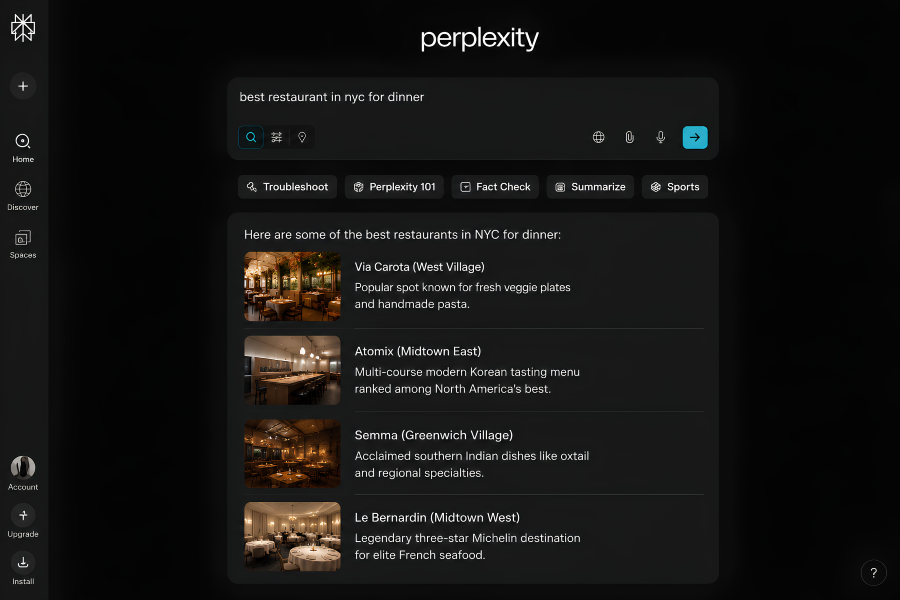
A growing share of NYC diners are no longer typing “best Italian restaurant West Village” into Google and scrolling through ten blue links. They are asking ChatGPT, Perplexity, or Google’s own AI Overviews the same question conversationally, and receiving a short, confident list of three or four recommendations with no further scrolling required. At My Chef Social, we are seeing this shift show up earlier and faster in restaurant discovery than in most other local business categories, because dining decisions are exactly the kind of specific, context-heavy question these tools are built to answer well. The restaurants that show up in that AI-generated shortlist are capturing a guest decision before the guest ever reaches a traditional search results page. The restaurants that don’t show up are not losing a ranking position. They are being left out of the conversation entirely.
This is the natural next step beyond the local search foundation covered in our Google Maps restaurant marketing guide, and it connects directly to the reputation signals covered in our companion piece on restaurant reputation management: the same review quality and consistency that wins the Google Maps Pack is a major input into whether an AI assistant recommends your restaurant at all.
What AI Search Optimization Actually Means for a Restaurant
Generative engine optimization, sometimes called AEO or GEO, is the practice of structuring your restaurant’s online presence so that AI models can confidently extract, understand, and recommend it when answering a diner’s question. Unlike traditional SEO, where a webpage competes for a ranking position, AI search draws from a blend of sources: your website, your Google Business Profile, your reviews, and third-party mentions across the web to construct a single confident answer. Being present and consistent across all of those sources matters more here than winning any single ranking spot.
Why Restaurant Discovery Is Especially Exposed to This Shift
Dining decisions are conversational by nature. A guest asking an AI assistant “where should I take a client for a business dinner in Midtown that isn’t too loud” is asking a question no traditional search engine answers well, but one an AI model can synthesize from restaurant descriptions, review sentiment, and even your own website copy about your dining room’s atmosphere. Restaurants that have never described their concept, atmosphere, or occasion-fit clearly in their own words, relying instead on generic stock phrases like “fine dining in the heart of the city,” are giving these models almost nothing usable to recommend them with confidence.
The Restaurant AI Search Readiness Framework
1. Write Content That Answers Specific Questions, Not Generic Descriptions
AI models pull confidently from content that directly answers a specific question: what makes this restaurant good for a date night, a business dinner, a solo counter meal, or a large group celebration. A generic “About Us” page rarely gives a model enough specificity to recommend the restaurant for any particular occasion. This is the same specificity principle covered in our restaurant competitor analysis guide: the operators who understand exactly what makes their concept distinct are the ones whose content, human or AI-read, actually gets used.
2. Keep Your Google Business Profile and Website in Perfect Agreement
AI models cross-reference multiple sources to build confidence in a recommendation. A restaurant whose website describes one atmosphere while its Google Business Profile and third-party listings describe another creates the kind of inconsistency that reduces a model’s confidence in recommending it at all. The profile discipline covered in our Google Maps marketing guide is directly relevant here, since a complete, consistent, and frequently updated profile is one of the clearest signals an AI system can draw from.
3. Treat Review Content as Training Data, Not Just Social Proof
Reviews that mention specific dishes, specific occasions, and specific neighborhood context carry outsized value for AI-driven recommendations, in the same way they carry outsized weight in Google’s local ranking algorithm. A review that says a restaurant is “perfect for a quiet anniversary dinner, the corner tables are private, and the tasting menu pacing is unhurried” gives an AI model exactly the kind of specific, occasion-matched language it needs to recommend that restaurant confidently. Our reputation management guide covers how to prompt guests toward this kind of specific, useful review language.
4. Make Sure Your Technology Stack Surfaces Accurate, Current Information
A stale menu, outdated hours, or incorrect pricing pulled by an AI model into a confident answer creates a guest experience failure before the guest even arrives. Our restaurant technology guide covers the integration discipline that keeps your menu, hours, and availability accurate across every platform an AI model might be drawing from.
5. Build Content Around Repeat-Visit Proof, Not Just First-Visit Appeal
AI models increasingly weigh guest loyalty signals, repeat mentions, returning-customer language in reviews, and consistent positive sentiment over time, as a marker of restaurant quality. The retention thinking covered in our guide on restaurant customer loyalty and repeat guest revenue has a second, less obvious payoff here: a restaurant with a visible base of returning guests generates exactly the kind of trust signal that strengthens an AI-driven recommendation.
6. Feed the Same Specificity Into Your Short-Form Video Captions
Video captions, alt text, and on-screen text are increasingly indexed and read by AI models the same way page copy is. The specificity principle covered in our restaurant TikTok marketing guide, naming the exact dish, technique, or ingredient rather than a generic caption, does double duty: it performs better with human viewers and gives AI systems another confident, specific data point to draw from when constructing a recommendation.
Traditional SEO vs. AI Search Readiness
Dimension | Traditional SEO Focus | AI Search Readiness Focus |
Primary goal | Rank in top search results | Be confidently recommended in a synthesized answer |
Content style | Keyword-optimized pages | Specific, occasion-answering, conversational content |
Key signal | Backlinks and on-page optimization | Cross-source consistency and review specificity |
Review role | Social proof and star rating | Direct input data for AI-generated recommendations |
This comparison reflects the current, rapidly evolving relationship between traditional search and generative AI search behavior. Expect the specific mechanics to continue shifting through 2026 and beyond.
Want your restaurant’s digital presence built to be found by both search engines and AI assistants?
The restaurant website design and restaurant social media marketing team at My Chef Social builds the content and profile consistency that positions NYC restaurants ahead of this shift.
A Final Word: The Search Box Is Disappearing. The Decision It Powers Isn’t.
Guests will keep deciding where to eat tonight regardless of which interface they use to ask the question. The restaurants that adapt early, writing specific, occasion-matched content, keeping every platform in agreement, and treating reviews as data rather than decoration, are positioning themselves to be part of that decision no matter how it’s being made. The restaurants that wait for this shift to fully mature before responding will be trying to catch up to a recommendation habit that guests have already formed around their competitors.
At My Chef Social, we help NYC restaurants stay ahead of where guest discovery is actually heading, not just where it’s been.
Book your free growth audit today
Frequently Asked Questions
What is AI search optimization for restaurants?
AI search optimization, sometimes called generative engine optimization or AEO, is the practice of structuring a restaurant’s website content, Google Business Profile, and reviews so that AI models like ChatGPT, Perplexity, and Google’s AI Overviews can confidently understand and recommend the restaurant when answering a diner’s question.
How is AI search different from traditional restaurant SEO?
Traditional SEO competes for a ranking position within a list of search results. AI search synthesizes a single, confident answer from multiple sources at once, including your website, Google Business Profile, and reviews. Being consistent and specific across all of those sources matters more than optimizing any single page for a keyword.
Why do reviews matter more for AI search than people realize?
AI models draw directly on review language to understand what a restaurant is actually like and who it’s best suited for. Specific reviews mentioning particular dishes, occasions, or atmosphere details give these models the language needed to recommend a restaurant confidently for a specific type of guest request.
Can a small independent restaurant compete with larger chains in AI search results?
Yes, in many cases more effectively than in traditional paid search, since AI recommendations are driven by content specificity and consistency rather than advertising budget. A small restaurant with clear, occasion-specific content and consistent, detailed reviews can outperform a larger competitor with generic, inconsistent information across its platforms.
What is the first step a restaurant should take toward AI search readiness?
Audit whether your website content actually describes what makes your restaurant distinct and which occasions it suits best, rather than relying on generic descriptive language. Then confirm that your Google Business Profile and third-party listings tell the same story, since inconsistency across sources is one of the clearest ways to be excluded from a confident AI recommendation.